VERIFY IT YOURSELF

Do not just trust the platform—verify the reveal yourself

Start with the reveal proof for a quick check, then use Arbiscan to compare the platform data with the transactions left by the smart contract. This guide walks through both levels step by step.

CHAPTER 01 · REVEAL PROOF

How do I read a reveal proof?

Start with the player-facing information, then work down to the calculation. You do not need to understand every hexadecimal value at first.

01

Confirm this is your reveal

Check the series name and number, reveal time, ticket count, and every draw ticket ID. This rules out using the wrong proof or batch.

The draw ticket IDs on the proof must match the tickets you actually held or revealed.

02

Check what each ticket revealed

The reveal result lists the prize group and prize name for each draw ticket ID. Keep this result so you can compare it with the public record later.

Do not rely only on the image. Draw ticket ID, prize group, and prize identifier are the values that matter.

03

Confirm all three reveal steps

Reveal submission, VRF fulfillment, and on-chain prize assignment should all be complete. A pending VRF means the external randomness has not returned, so the proof is not complete yet.

VRF status should be Fulfilled and result status should be Assigned.

04

Open Advanced Verification

Advanced Verification shows the original VRF seed, each ticket's derived random value, the remaining total, the modulo result, and the prize range containing that result.

The calculated prize group should match the prize group shown in the result.

The advanced verification formula

One on-chain seed becomes a random value for every ticket

In V2, tickets in one batch share a Chainlink VRF seed. Following the RevealDrawSent.tokenIDs array, the system encodes the seed, draw ticket ID, and array index before hashing them, so every ticket receives different randomness. Legacy events that provide one randomWords value per ticket use those values directly.

Public calculation
randomWord = keccak256(abi.encode(uint256(seed), uint256(tokenId), uint256(index)))prizeIndex = randomWord % totalRemaining

index

This is the zero-based index in the tokenIDs array: the first element is 0 and the second is 1. Draw ticket IDs are not numerically sorted.

totalRemaining

The total number of prizes remaining immediately before this ticket is revealed.

prizeIndex

Whichever cumulative prize range contains the remainder is the winning group.

Within a batch, tickets follow tokenIDs array order and each prize is removed before the next calculation. When several VRF requests are pending, the pool updates in callback completion order on-chain, not submission order.

CHAPTER 02 · ON-CHAIN CHECK

How do I compare the record on Arbiscan?

The platform proof is a readable summary. Arbiscan shows the public record actually received and executed by the blockchain. Complete verification compares both.

Real example · Reveal request

MAINNET · Production record

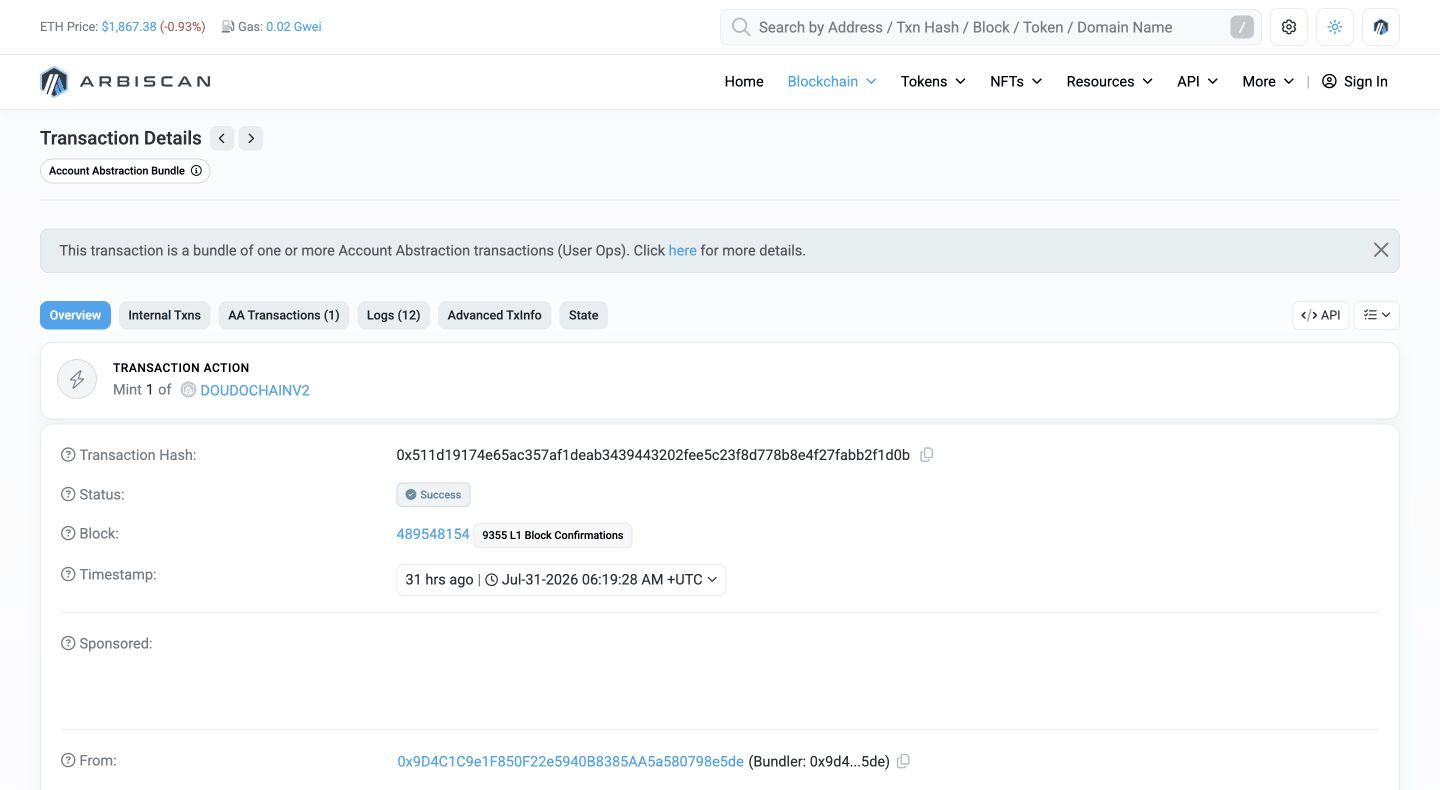
Start by checking the transaction identity in Overview

This is the real transaction for series No.0 and draw ticket ID 9. The screenshot preserves Arbiscan's original fields and values.

These are real reveal transactions on Arbitrum One. Their transaction hashes, events, and VRF fulfillment data are publicly verifiable on Arbiscan.

Open this live transaction
Real Arbiscan reveal request showing transaction hash, success status, block, and timestampOpen the full transaction

01 · Transaction Hash

Compare it character by character with the full Tx Hash on the proof.

02 · Status / Block

Confirm execution succeeded, then compare the block and time.

03 · Logs

Open Logs to find RevealDrawSent and the draw ticket ID.

This example reveals immediately after purchase, so Arbiscan summarizes the transaction action as Mint. The reveal request is still recorded in the same transaction's Logs. Do not rely only on the action summary.

1

Open the full Tx Hash

Find the Tx Hash on the proof and confirm that it opens https://arbiscan.io on Arbitrum One (Chain ID 42161). Do not compare only a shortened 0x1234…abcd value—compare the complete transaction hash.

2

Check the transaction receipt

Confirm Status is Success, then compare the full Tx Hash, block, and time. Success only means the transaction executed; it does not by itself prove a fair reveal. The event data still needs to be checked.

3

Find the reveal request in Logs

Open Logs or Events and find RevealDrawSent. Compare its requestId and tokenIDs to confirm that the request contains the tickets shown on the platform proof.

4

Match the VRF fulfillment by requestId

VRF is asynchronous, so fulfillment normally happens in a separate transaction. Open the transaction linked from VRF Randomness Delivered, find RevealDrawFulfilled, confirm the same requestId, and note randomWords[0].

5

Compare the final ticket state

Find UpdateTicketStatus in the fulfillment transaction and compare the draw ticket ID, series ID, reveal status, and prize ID. If the explorer can decode the contract, you can also use Read as Proxy to inspect the current on-chain state.

6

Recalculate each ticket from the seed

Arbiscan records the shared seed for the batch. Derive each ticket's random value with the public formula, take the modulo against the remaining total before that ticket, and confirm that the resulting prize range matches the platform result.

Real example · VRF fulfillment

MAINNET · Production record

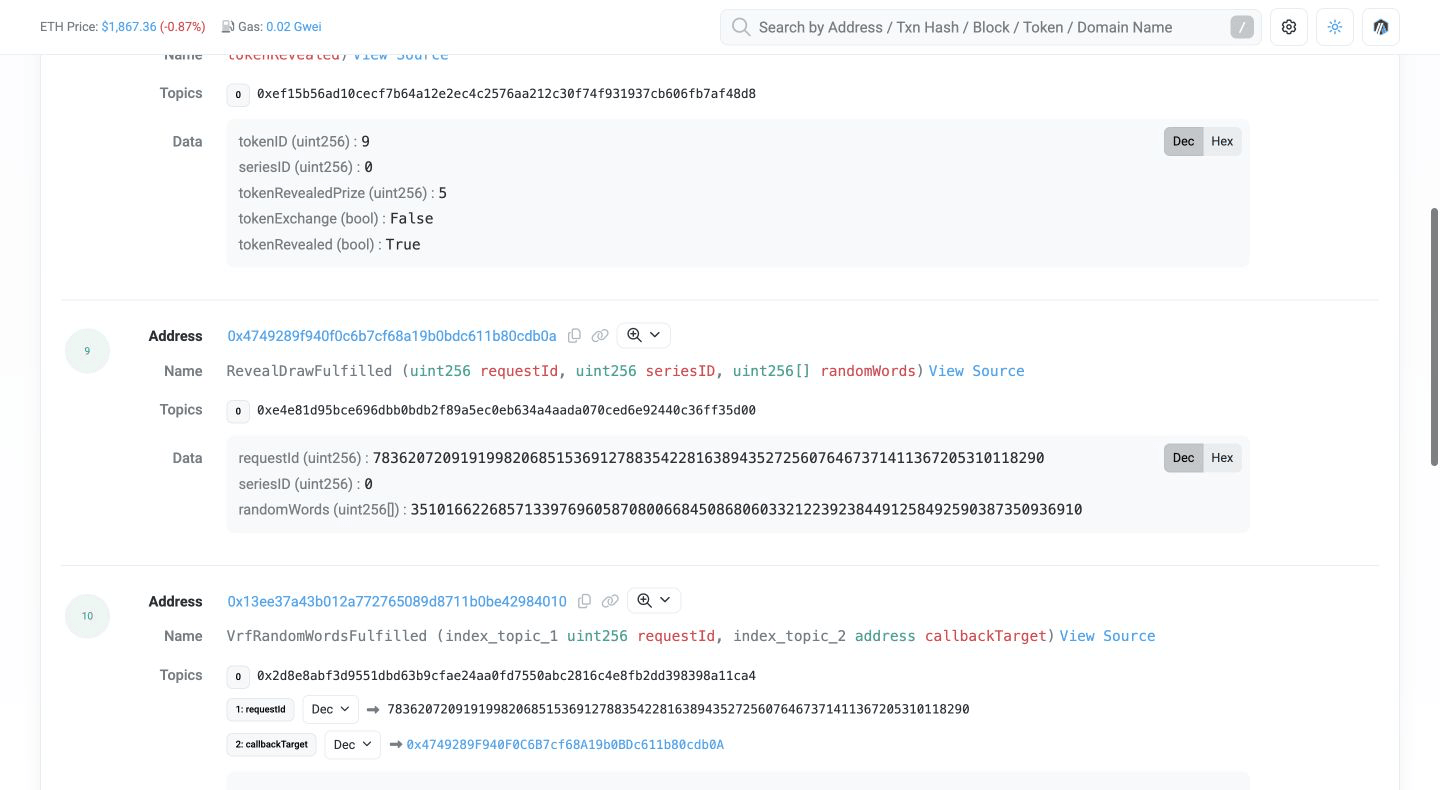
The same transaction records randomness and the final prize

This is the fulfillment transaction for the request above. Draw ticket ID 9, series 0, prize ID 5, requestId, and randomWords are all visible.

Open this fulfillment transaction
Real Arbiscan VRF fulfillment events showing ticket status, requestId, and randomWordsOpen the full transaction

UpdateTicketStatus

Draw ticket ID 9, series ID 0, prize ID 5, and reveal status is True.

RevealDrawFulfilled

The requestId links back to the request, and randomWords is the on-chain VRF seed.

VrfRandomWordsFulfilled

Confirms that the VRF router returned randomness to the Doudo Chain core contract.

Why is one transaction not enough?

The player first submits a reveal request, and Chainlink VRF returns randomness later. Request and fulfillment are separate transactions linked by the exact same requestId—not merely by similar timestamps.

Complete verification checklist

Series number, draw ticket IDs, and reveal time match

Request, VRF fulfillment, and prize assignment are complete

The Tx Hash opens and its full value, block, and time match

RevealDrawSent and RevealDrawFulfilled share the same requestId

On-chain randomWords[0] matches the VRF seed on the proof

Each calculated prize group matches the displayed result

Now verify a real reveal

Choose a completed reveal proof and follow the checklist. Real transparency means players can inspect the evidence without asking the platform for permission.